Full-stack builder · Ranked 3 of 33 in the index
Lovable Review (2026)
A prompt-to-app builder that ships a React front end with a managed Postgres backend, and hands you the repository when you want it.
 4.2 / 5Last verified: · Next scheduled check:
 The quick answer
Assessed for 2026Buy, with one eye on the meter. Lovable is the most complete of the chat-first builders: the generated interfaces are the best looking of any chat-first builder here by a clear margin, the Supabase integration means auth and a real relational database arrive in the first ten minutes rather than the third week, and the GitHub sync is honest two-way sync rather than a zip download. Our panel built the same booking app on every tool in the launch cohort; Lovable was one of only four that produced something we would have been willing to put in front of a paying customer without a rewrite. What you are buying is the first eighty percent, delivered faster and prettier than anywhere else.
- Best for
- Founders and product teams who want a good-looking, genuinely deployable SaaS front end in an afternoon
- Not for
- Teams with heavy custom backend logic, strict data residency rules, or a fixed monthly budget they cannot exceed
- Price from
- USD 25 / month, billed monthlyPro plan.
- Free tier
- Yes
The ten axes
Every builder in the index is scored on the same ten axes with the same published weights. This is how Lovable performed on our test briefs.
- Reliability16%
- 4.0
- Integrations16%
- 4.5
- SEO and GEO13%
- 4.0
- Design quality12%
- 4.7
- Agent performance10%
- 4.4
- Speed9%
- 4.6
- Value9%
- 3.9
- Scalability7%
- 3.8
- API and MCP access5%
- 4.0
- Code ownership3%
- 4.5
Every axis is scored from 0 to 5 stars. The percentage is that axis's published weight in the overall 4.2 rating.
The verdict
Buy, with one eye on the meter. Lovable is the most complete of the chat-first builders: the generated interfaces are the best looking of any chat-first builder here by a clear margin, the Supabase integration means auth and a real relational database arrive in the first ten minutes rather than the third week, and the GitHub sync is honest two-way sync rather than a zip download. Our panel built the same booking app on every tool in the launch cohort; Lovable was one of only four that produced something we would have been willing to put in front of a paying customer without a rewrite. What you are buying is the first eighty percent, delivered faster and prettier than anywhere else.
A prompt-to-app builder that ships a React front end with a managed Postgres backend, and hands you the repository when you want it.
The dissenting view
The dissent is about the last twenty percent and what it costs. Two of our five panellists argued Lovable should score below Replit, because the moment your app stops looking like a CRUD dashboard the agent starts burning credits on repeated near-misses, and the credit model turns debugging into a metered activity. One reviewer spent 40 credits fixing a row-level security policy that a developer would have fixed in nine minutes. If you already have engineers, they contend, you are paying a premium for scaffolding you could generate once and own forever.
One member of the panel disagreed with the consensus. We publish the disagreement rather than average it away.
What it looks like
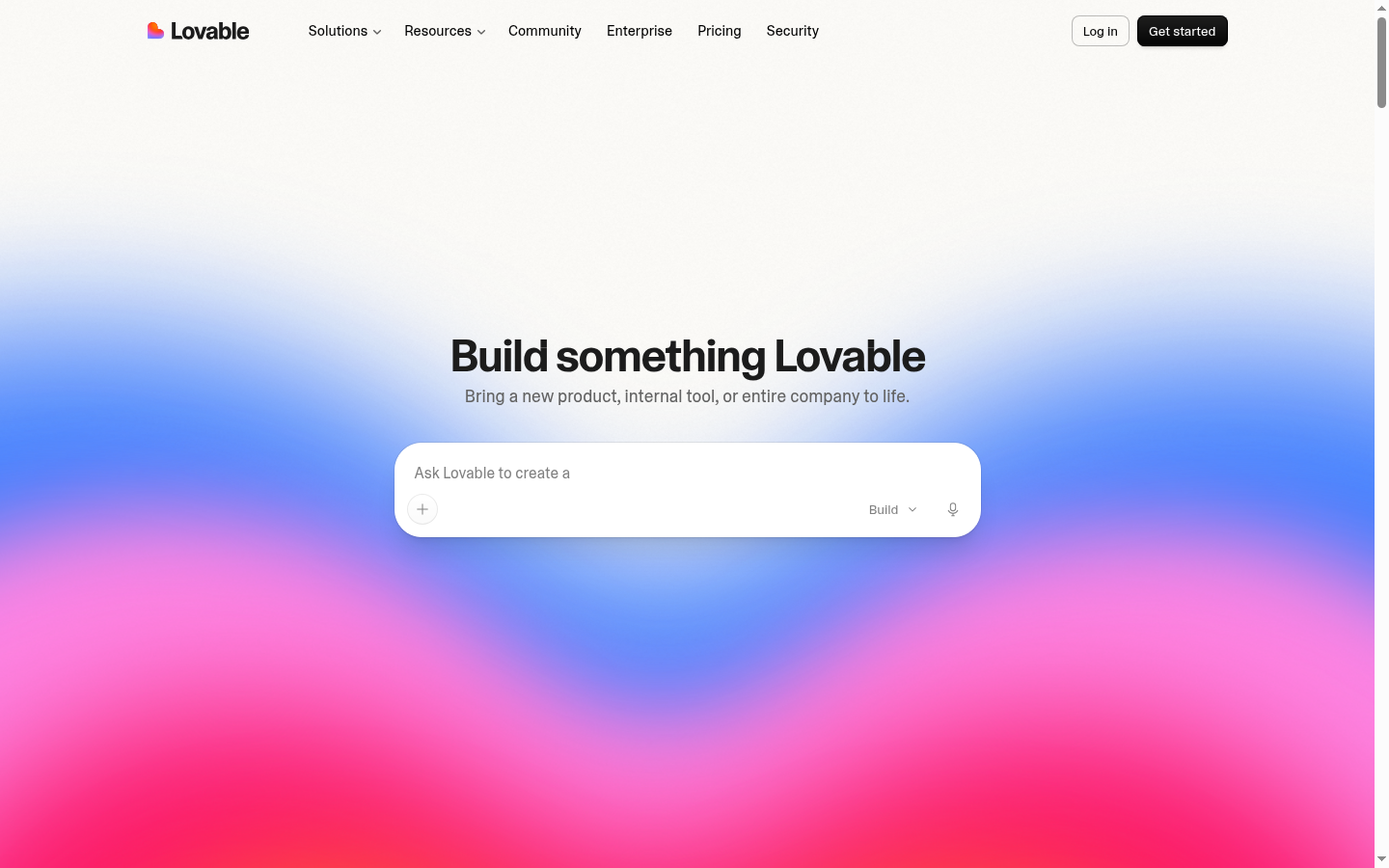
Pricing
Free plan with a monthly credit allowance. Pro at USD 25 a month, with credit top-ups sold separately.
| Plan | Price | Billing | What you get |
|---|---|---|---|
| Free | Free | monthly | Daily and monthly credit allowance, public projects, Lovable subdomain |
| Pro | USD 25 | monthly | Monthly credit pool, private projects, custom domains, GitHub sync |
| Business | Not captured | monthly | Larger credit pool, seats, SSO, design system controlsPlan exists, price not captured in our 19 and 20 August 2026 check. |
| Enterprise | On request | quote | Volume credits, procurement, security review |
We list the plans we could verify on the vendor's own pricing page. Where a plan exists but its price was not published in a form we could capture, the row says so rather than carrying a number we cannot source.
Feature by feature
The same eleven checks, run on every builder in the index.
| Capability | Status |
|---|---|
| Full-stack backend | Yes |
| Database included | Yes, Supabase Postgres |
| Auth included | Yes |
| Code export | Yes, full repository |
| GitHub sync | Yes, two-way |
| One-click deploy | Yes |
| Custom domain | Yes, paid plans |
| Mobile or native output | Responsive web only |
| Team collaboration | Yes, paid plans |
| Public API or MCP server | Yes |
| Self-hosting the output | Yes, you own the repo |
What works / What does not
What works
- Best-looking default output of any chat-first builder we tested, and it holds up on mobile
- Supabase integration gives you a real relational database and auth on day one
- Two-way GitHub sync means you are never locked out of your own code
- The agent explains its plan before editing, which makes review possible
What does not
- Credit consumption is unpredictable once you leave the happy path
- Backend logic beyond CRUD still needs a developer to finish
- Scaling past the Supabase defaults becomes your problem, not the platform
- Long chat sessions gradually lose the thread of earlier decisions
User reviews
Lovable holds 118 star ratings and 5 written reviews. They are counted separately: every written review carries a rating, but most ratings arrive without one. Editor panel reviews are shown first and badged.
Community rating
- 5 ★66%
- 4 ★20%
- 3 ★6%
- 2 ★3%
- 1 ★5%
Sign in to rate Lovable. Reading needs no account.
Write a review of Lovable
You need an account to post, because one rating per person is the only way the averages mean anything. Reading never needs one.
- Editor panel
The prettiest first draft, and a metered second draft
Ines Varela@inesvarela
Senior reviewer, front end and accessibility. Audits every generated interface against WCAG 2.2 AA.
We ran all six briefs through Lovable three times each. It completed five of six on the first attempt, which nothing else in the index managed, and the booking flow it produced passed our accessibility audit with two minor focus-order fixes. The turn comes at brief four, the one with row-level security. Across three runs the agent needed eleven, fourteen and nine prompts to get the policy right, and each failed attempt cost credits. That is the whole review in one paragraph: outstanding at the part everyone demos, expensive at the part everyone actually ships.
- Pros
- Highest first-attempt completion rate in the panel. Accessibility defaults are real, not decorative. GitHub sync worked in both directions every time we tested it.
- Cons
- Credit cost per fixed bug is the least predictable of the leaders. Long sessions lose earlier architectural decisions.
3 replies
Dev_Marco
4 September 2026
The row-level security point matches my experience exactly. Eleven prompts sounds optimistic honestly.
Sara L.
5 September 2026
Would be useful to see the actual credit spend per brief published alongside the scores.
Owen Pryce@owenpryce
5 September 2026
Fair request. Per-brief spend is in the testing spec on our methodology page and we are working on publishing the raw logs.
Sign in to reply.
- Editor panel
Took me from nothing to paying customers in five weeks
Priya Ramanathan@priyabuilds
Solo founder, B2B scheduling tool.
I am not a developer. I have shipped a real scheduling product with 40 paying accounts on it and Lovable built almost all of it. The Supabase integration was the thing that mattered: I did not have to understand what a database was, but I ended up with a proper one. I did pay for two hours of a contractor to fix the permissions setup because I could not get the agent there, which felt like a fair trade.
- Pros
- Looks professional with zero design input from me. Real database rather than a toy one.
- Cons
- I hit the credit ceiling twice in month two and had to buy top-ups.
0 replies
No replies yet.
Sign in to reply.
- Editor panel
We use it for client discovery, then rewrite
Marc Delaunay@marcdln
Tech lead at a 30 person agency.
Our pattern is Lovable for the first week of a client engagement, then we take the repo and rewrite the data layer properly. That workflow is worth a lot: the client sees something real on day three instead of a Figma file, and we start with a working shape instead of a blank page. Four stars rather than five because the generated backend code is the part we always end up replacing.
- Pros
- Excellent for client-facing discovery. Repo export is clean and reviewable.
- Cons
- Backend code quality lags the front end noticeably.
0 replies
No replies yet.
Sign in to reply.
- Editor panel
Great until we needed integrations we already owned
Hannah Weiss@hweiss
Operations manager, logistics.
Building the interface was a genuine pleasure. Connecting it to our existing warehouse API was two weeks of fighting, mostly because the agent kept regenerating the fetch layer and losing the auth header handling I had corrected. Ended up asking a developer to finish it. Three stars is not a complaint about the product, it is a warning about where the line sits.
- Pros
- Interface work is fast and the results are good.
- Cons
- Regenerations overwrite hand corrections in the integration layer.
0 replies
No replies yet.
Sign in to reply.
- Editor panel
Best in class, still not a replacement for knowing what you want
Sam Oduya@samoduya
Indie developer, three shipped side projects.
I have used Bolt, v0 and Lovable in anger. Lovable is the one I renew. The difference is not the first prompt, it is prompt forty: it still knows what the app is. My advice to anyone reading a review site before buying is that the agent quality is now less important than the surrounding platform, and Lovable has the better platform.
- Pros
- Holds project context better than rivals. Platform pieces are all present.
- Cons
- You still need a clear specification, it will happily build the wrong thing well.
0 replies
No replies yet.
Sign in to reply.
Frequently asked
- Is Lovable worth the money in 2026?
- For a first version of a customer-facing web app, yes. Our panel rated it 4.2 stars overall, third in this index behind Totalum and Cursor. The caveat is the credit model: budget roughly double what you expect for anything involving custom backend logic, because failed agent attempts still consume credits.
- Do you own the code Lovable generates?
- Yes. Lovable syncs to a GitHub repository you control, and the output is a standard React and Vite project with a Supabase backend. You can walk away with it and keep building by hand.
- Can Lovable build a production SaaS, not just a prototype?
- It can carry a small SaaS to launch, and several of ours did. Past a few thousand users you are managing Supabase yourself, and the agent stops being the fastest way to change anything complicated.
- What is the main reason to pick something else?
- A fixed budget or heavy backend work. Replit gives you a real Linux environment and predictable compute pricing; v0 gives you a cleaner front end if you already have an API.
Sources
Where these numbers come from
- Price
- Lovable pricing page · 14 August 2026
- Axis scores
- Our own testing panel: six briefs, three runs each, eighteen runs per tool, scored against the published rubric · 20 August 2026
- Community rating
- Computed from the 118 star ratings held in our own database for this tool · 20 August 2026
Everything we read for this review
- Lovable pricing page · 14 August 2026
- Lovable documentation · 14 August 2026
- Lovable changelog · 12 August 2026