Head to head
WeWeb vs Plasmic (2026)
Plasmic takes the overall rating, but this pairing is decided on axes rather than totals: WeWeb leads 5 of the ten, Plasmic leads 5.

WeWeb
A front-end builder for people who already have a backend and standards
3.9out of 5
The professional choice in this bracket, with one caveat that moved its score. WeWeb takes 4.4 on integrations because it treats a web application as something that has to be connected to real data, and WeWeb Cloud now ships a real managed backend of its own: a managed database, lambda compute, file storage and transactional email, which is why we have changed its category rather than calling it a pure front-end tool. SEO is the loss, at 3.1. The output is a Vue.js single-page application, and the vendor's own cheapest hosting tier is named "Static sites and SPAs", so unless the customer adds a rendering layer of their own, crawlers and LLM fetchers get an empty shell. Two commercial facts matter more than the sticker price. WeWeb does not charge per app user on any tier, and end users, APIs and workflows are unlimited everywhere, which is a decisive advantage over Softr and Retool as an audience grows. Against that, MCP is effectively a Pro feature at USD 50 a month per developer, with a 14-day trial on Free and no listing on Essential, and the Free tier cannot export code, so ownership, the platform's headline promise, is paywalled.
- Price from
- USD 20 / month, billed monthly
- Best for
- Agencies and product teams building a real front end over Xano, Supabase or an existing API
- Ratings
- 17

Plasmic
A visual layer for React codebases that engineers do not resent
4.0out of 5
The best engineering fit of any visual tool here. Plasmic renders into your own React or Next.js app, so pages stay fast and indexable, scoring 4.4 on speed and 4.3 on SEO and GEO, and code ownership at 4.3 is near the top because your repository never stops being yours. The rendering mode on that SEO axis is decided by your host codebase rather than by Plasmic, which is the honest way to read the score. The API mark of 3.2 is the one that needs explaining: the "Extended platform APIs", white labeling and embedding are Enterprise-only features with no published API reference and no published price, so a buyer below Enterprise cannot evaluate the programmable surface at all. Version history is tier limited too, from 14 to 180 days depending on plan. AI features are minor and the initial integration needs a developer for a day. If you have engineers and a marketing team who keep filing page-edit tickets, this pays for itself immediately.
- Price from
- USD 39 / month, billed yearly
- Best for
- Product and marketing teams who want visual editing inside a codebase engineers already own
- Ratings
- 14
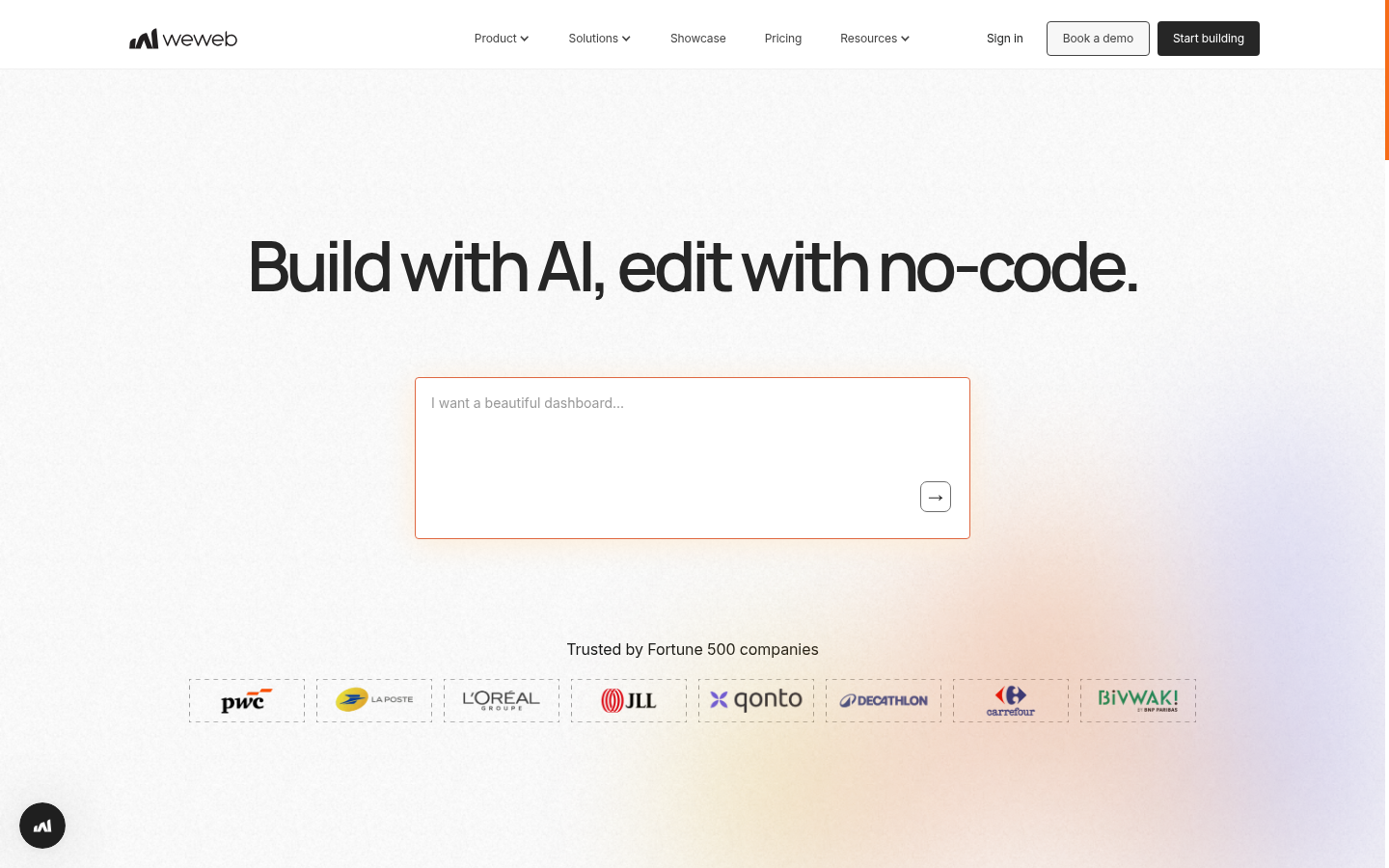
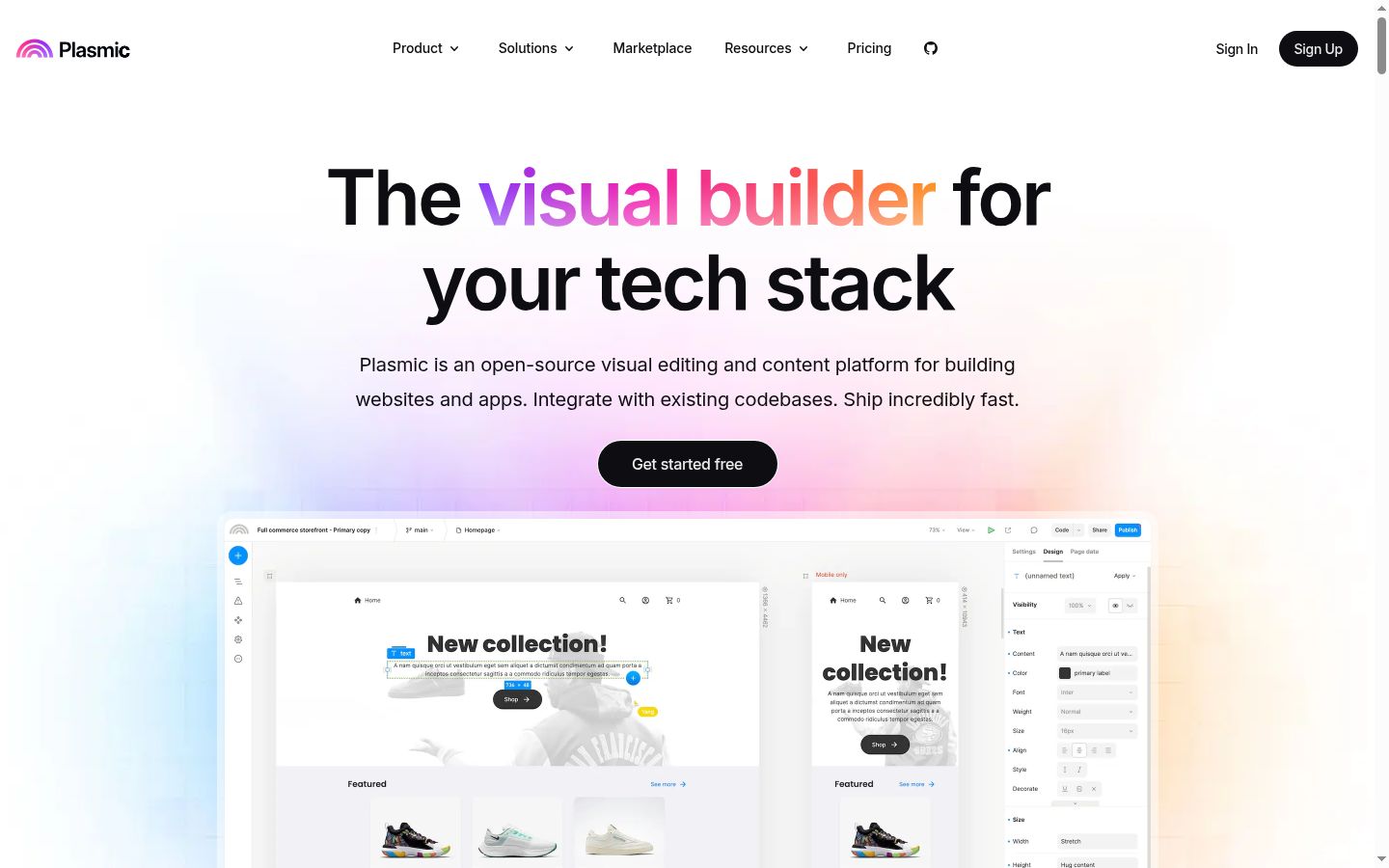
What each one looks like
Axis by axis
The leader on each axis is set in bold. The weight column is what that axis contributes to the overall rating, so a win on reliability counts for more than five times a win on code ownership.
| Axis | Weight | WeWeb | Plasmic | Leader |
|---|---|---|---|---|
| Reliability | 16% | 4.3 | 4.2 | WeWeb |
| Integrations | 16% | 4.4 | 4.0 | WeWeb |
| SEO and GEO | 13% | 3.1 | 4.3 | Plasmic |
| Design quality | 12% | 4.1 | 4.2 | Plasmic |
| Agent performance | 10% | 3.2 | 3.0 | WeWeb |
| Speed | 9% | 4.2 | 4.4 | Plasmic |
| Value | 9% | 3.8 | 3.7 | WeWeb |
| Scalability | 7% | 4.0 | 4.1 | Plasmic |
| API and MCP access | 5% | 4.2 | 3.2 | WeWeb |
| Code ownership | 3% | 3.5 | 4.3 | Plasmic |
| Overall, weighted | 100% | 3.9 | 4.0 | Plasmic |
Axis definitions and the full weighting are on how we review. Both tools last verified 20 August 2026.
Where the capabilities differ
| Capability | WeWeb | Plasmic |
|---|---|---|
| Full-stack backend | Optional, WeWeb Cloud ships a managed database, lambda compute, file storage and transactional email, or connect your own | No |
| Database included | Optional, WeWeb Cloud managed database, or bring Xano, Supabase or an API | No, connect your own |
| Auth included | Yes, via your provider | Bring your own |
| Code export | Yes, Vue export on higher plans. The Free tier cannot export | Yes, generates real components |
| GitHub sync | Limited | Yes, codegen into your repo |
| One-click deploy | Yes, or self-host the export | Yes, or ship with your app |
| Custom domain | Yes, paid plans | Wherever you host |
| Mobile or native output | Responsive web and PWA | Responsive web only |
| Team collaboration | Yes | Yes, with roles |
| Public API or MCP server | Connects to any REST or GraphQL source. MCP is effectively a Pro feature at USD 50 a month per developer, with a 14-day trial on Free and no listing on Essential | Headless API, yes. Extended platform APIs, white labeling and embedding are Enterprise only, with no published API reference and no published price |
| Self-hosting the output | Yes, with code export | Yes, it runs inside your app |
Shaded rows are the ones where the two differ.
What each one costs
WeWeb
The free plan can publish, up to 1,000 sessions on a WeWeb subdomain. The editor starts at USD 20 a month, and publishing on a custom domain with a database adds Launch+ at USD 20, so about USD 40.
Essential plan, which is the editor only. The free plan can publish up to 1,000 sessions on a WeWeb subdomain. Publishing on a custom domain with a database needs Essential USD 20 plus Launch+ USD 20, so about USD 40 a month.
| Plan | Price |
|---|---|
| Free | Free |
| Essential | USD 20 |
| Launch+ | USD 20 |
| Scale | Not captured |
Plasmic
The Free plan has unlimited projects, publishes, syncs, workspaces, cross-project imports and headless CMS entries. What it meters is collaborators, three of them. Paid plans from USD 39 a month billed yearly.
Starter plan, billed yearly. The monthly-billed rate is not published without JavaScript. Extra seats are USD 20 each on Pro, and Pro is USD 103 a month billed yearly for up to 10 collaborators.
| Plan | Price |
|---|---|
| Free | Free |
| Starter | USD 39 |
| Pro | USD 103 |
| Scale | USD 399 |
Prices are shown in the currency each vendor publishes, never converted. Sorting by price groups the currencies and orders within each one, so it is not an exact cross-currency comparison.
We list the plans we could verify on the vendor's own pricing page. Where a plan exists but its price was not published in a form we could capture, the row says so rather than carrying a number we cannot source.
Which one should you choose
Pick WeWeb if your project looks like agencies and product teams building a real front end over xano, supabase or an existing api. Its strongest axes in this pairing are reliability, integrations, agent performance. Avoid it for solo founders who want the backend built for them from a prompt.
Pick Plasmic if your project looks like product and marketing teams who want visual editing inside a codebase engineers already own. Its strongest axes here are seo and geo, design quality, speed. Avoid it for anyone without a react codebase or an engineer to wire it in.
And the dissenting notes, which we publish rather than average away: on WeWeb, One panellist wanted a higher value score, noting agencies bill the build anyway. The mark accounts for the fact that a working product needs a second paid tool underneath. On Plasmic, The testing lead argued Plasmic is a CMS rather than an app builder. The panel kept it in because it generates interactive components, not just content.
Frequently asked
- Is WeWeb better than Plasmic?
- On our weighted overall rating, Plasmic scores higher: 3.9 for WeWeb against 4.0 for Plasmic. Axis by axis it is closer than that sounds. WeWeb leads 5 of the 10 axes that apply to both, Plasmic leads 5, and 0 are tied. The right choice depends on which axes you weight, not on which total is larger.
- Which is cheaper, WeWeb or Plasmic?
- WeWeb starts at USD 20 / month, billed monthly and Plasmic starts at USD 39 / month, billed yearly. Each figure is the vendor's own published price and currency, not converted, so compare the pricing models rather than the two numbers: WeWeb bills as the free plan can publish, up to 1,000 sessions on a weweb subdomain. the editor starts at usd 20 a month, and publishing on a custom domain with a database adds launch+ at usd 20, so about usd 40. and Plasmic bills as the free plan has unlimited projects, publishes, syncs, workspaces, cross-project imports and headless cms entries. what it meters is collaborators, three of them. paid plans from usd 39 a month billed yearly..
- Can I move a project from WeWeb to Plasmic?
- Only as far as code export allows. On the code ownership axis WeWeb scores 3.5 and Plasmic scores 4.3 out of five, which reflects how much of the running application you can take with you and whether it still works once moved.
- Which one is better for search visibility?
- On the SEO and GEO axis, which we weight at 13 percent, WeWeb scores 3.1 and Plasmic scores 4.3. That axis covers server rendered content, per route titles and canonicals, and whether the output is legible without JavaScript.