Head to head
Tempo vs Plasmic (2026)
Plasmic takes the overall rating, but this pairing is decided on axes rather than totals: Tempo leads 2 of the ten, Plasmic leads 8.

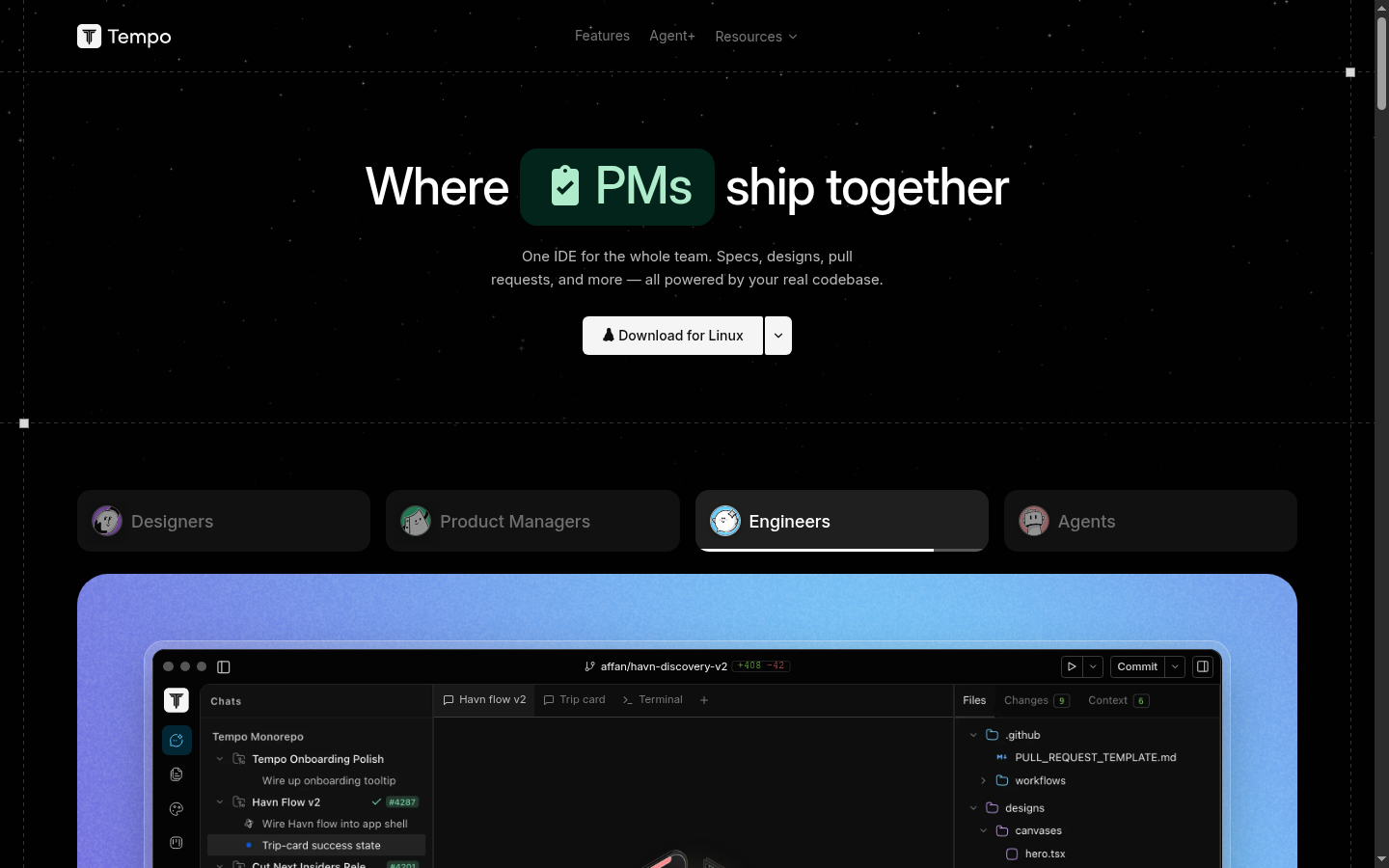
Tempo
A visual editor for React that treats the code as the source of truth
3.6out of 5
A good answer to a narrow problem. Tempo puts a canvas on top of an actual React repository rather than a proprietary document, so a designer can move a component and an engineer sees a normal diff. Code ownership at 4.4 reflects that honestly. It is not trying to build your backend, the agent is average, and if nobody on your team writes React the premise collapses. Buy it for the handoff problem, not for the building problem.
- Price from
- 24 EUR
- Best for
- Mixed teams where a designer and an engineer need to edit the same front end without fighting
- Ratings
- 13

Plasmic
A visual layer for React codebases that engineers do not resent
4.1out of 5
The best engineering fit of any visual tool here. Plasmic renders into your own React or Next.js app, so pages stay fast and indexable, scoring 4.4 on speed and 4.3 on SEO, and code ownership at 4.3 is near the top because your repository never stops being yours. AI features are minor and the initial integration needs a developer for a day. If you have engineers and a marketing team who keep filing page-edit tickets, this pays for itself immediately.
- Price from
- 35 EUR
- Best for
- Product and marketing teams who want visual editing inside a codebase engineers already own
- Ratings
- 38
What each one looks like

Axis by axis
The leader on each axis is set in bold. The weight column is what that axis contributes to the overall rating, so a win on reliability counts for more than five times a win on code ownership.
| Axis | Weight | Tempo | Plasmic | Leader |
|---|---|---|---|---|
| Reliability | 16% | 3.6 | 4.2 | Plasmic |
| Integrations | 16% | 3.3 | 4.0 | Plasmic |
| SEO and GEO | 13% | 3.5 | 4.3 | Plasmic |
| Design quality | 12% | 4.0 | 4.2 | Plasmic |
| Agent performance | 10% | 3.5 | 3.0 | Tempo |
| Speed | 9% | 3.9 | 4.4 | Plasmic |
| Value | 9% | 3.7 | 4.0 | Plasmic |
| Scalability | 7% | 3.4 | 4.1 | Plasmic |
| API and MCP access | 5% | 3.1 | 4.2 | Plasmic |
| Code ownership | 3% | 4.4 | 4.3 | Tempo |
| Overall, weighted | 100% | 3.6 | 4.1 | Plasmic |
Axis definitions and the full weighting are on how we review. Both tools last verified 14 August 2026.
Where the capabilities differ
| Capability | Tempo | Plasmic |
|---|---|---|
| Full-stack backend | No | No |
| Database included | Bring your own | No, connect your own |
| Auth included | Bring your own | Bring your own |
| Code export | Yes, it is your repository | Yes, generates real components |
| GitHub sync | Yes, two-way | Yes, codegen into your repo |
| One-click deploy | Yes, to common hosts | Yes, or ship with your app |
| Custom domain | Wherever you host it | Wherever you host |
| Mobile or native output | Responsive web only | Responsive web only |
| Team collaboration | Yes, this is the point | Yes, with roles |
| Public API or MCP server | No | Yes, headless API |
| Self-hosting the output | Yes, always | Yes, it runs inside your app |
Shaded rows are the ones where the two differ.
What each one costs
Tempo
Free tier for one project, paid plans from about 24 EUR per month
| Plan | Price |
|---|---|
| Free | Free |
| Pro | 24 EUR |
| Team | 60 EUR |
Plasmic
Free tier for small projects, paid plans from about 35 EUR per month
| Plan | Price |
|---|---|
| Free | Free |
| Starter | 35 EUR |
| Growth | 99 EUR |
Which one should you choose
Pick Tempo if your project looks like mixed teams where a designer and an engineer need to edit the same front end without fighting. Its strongest axes in this pairing are agent performance, code ownership. Avoid it for solo non-technical founders, who will not benefit from the thing that makes it interesting.
Pick Plasmic if your project looks like product and marketing teams who want visual editing inside a codebase engineers already own. Its strongest axes here are reliability, integrations, seo and geo. Avoid it for anyone without a react codebase or an engineer to wire it in.
And the dissenting notes, which we publish rather than average away: on Tempo, One panellist called the reliability mark harsh, noting every failure in our tests came from the underlying project rather than Tempo itself. The score covers the experience as delivered. On Plasmic, The testing lead argued Plasmic is a CMS rather than an app builder. The panel kept it in because it generates interactive components, not just content.
Frequently asked
- Is Tempo better than Plasmic?
- On our weighted overall rating, Plasmic scores higher: 3.6 for Tempo against 4.1 for Plasmic. Axis by axis it is closer than that sounds. Tempo leads 2 of the ten axes, Plasmic leads 8, and 0 are tied. The right choice depends on which axes you weight, not on which total is larger.
- Which is cheaper, Tempo or Plasmic?
- Tempo starts at 24 EUR and Plasmic starts at 35 EUR. Compare the pricing models rather than the entry price: Tempo bills as free tier for one project, paid plans from about 24 eur per month and Plasmic bills as free tier for small projects, paid plans from about 35 eur per month.
- Can I move a project from Tempo to Plasmic?
- Only as far as code export allows. On the code ownership axis Tempo scores 4.4 and Plasmic scores 4.3 out of five, which reflects how much of the running application you can take with you and whether it still works once moved.
- Which one is better for search visibility?
- On the SEO and GEO axis, which we weight at 13 percent, Tempo scores 3.5 and Plasmic scores 4.3. That axis covers server rendered content, per route titles and canonicals, and whether the output is legible without JavaScript.