Head to head
Mocha vs Trickle (2026)
Mocha takes the overall rating, but this pairing is decided on axes rather than totals: Mocha leads 8 of the ten, Trickle leads 2.

Mocha
Small, cheap, pleasant, and honest about its limits
3.6out of 5
Buy for small things and mean it. Mocha does not pretend to be a platform. It builds small web apps quickly, the editor is the least intimidating in this index after Base44, and the pricing is honest enough that our testers never worried about the meter, which is a rarer virtue here than it should be. It earned 4.1 on value, third highest overall. What it will not do is grow with you: scalability at 3.1 and API access at 2.7 both sit in the bottom three of the index, and both are structural rather than a roadmap gap.
- Price from
- 15 EUR
- Best for
- Side projects, small internal utilities and single-purpose tools where cost discipline matters more than ambition
- Ratings
- 29

Trickle
The most tasteful output here, attached to the least capable backend
3.5out of 5
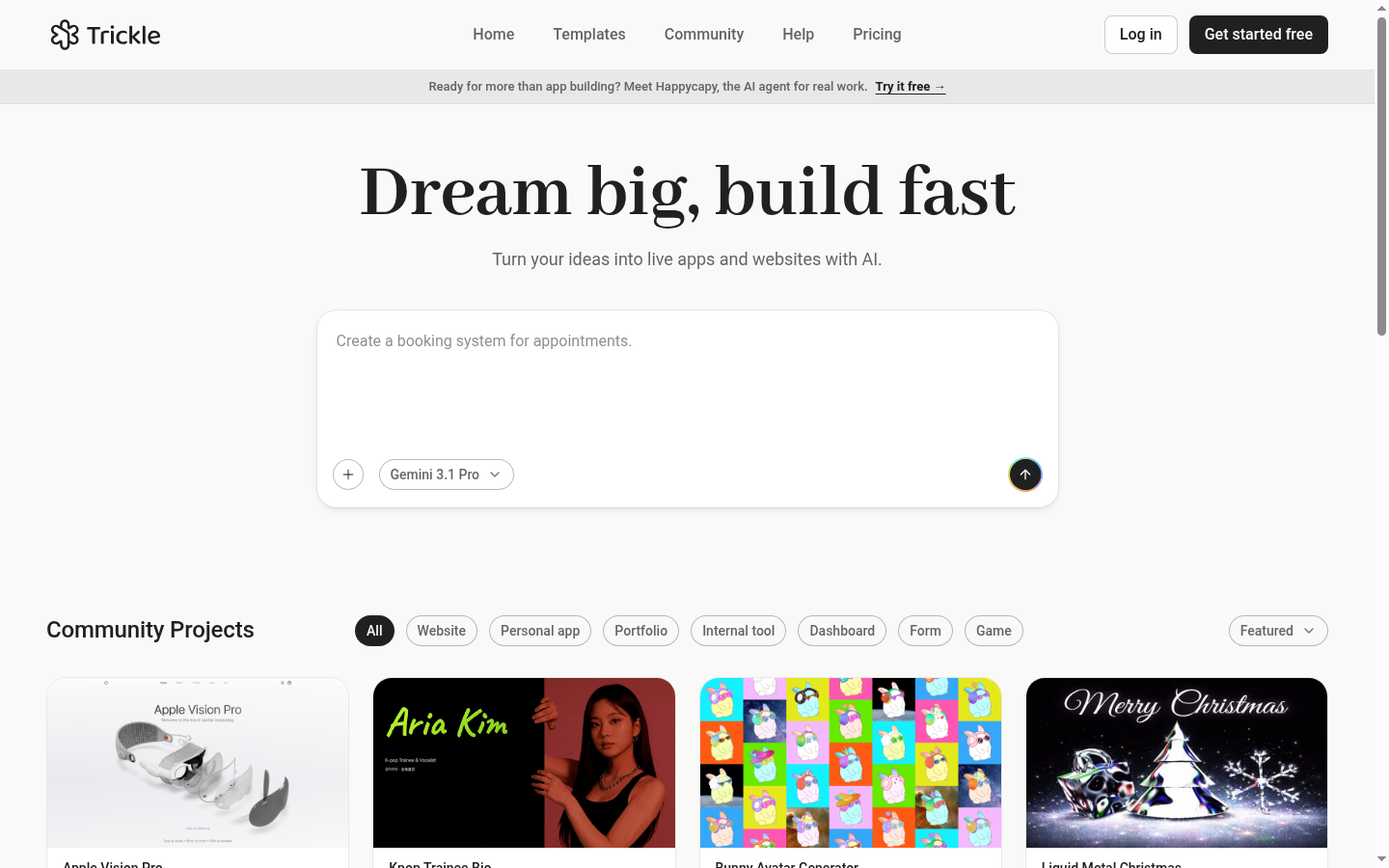
Buy on looks, and know what you are buying. Trickle produces the most tasteful output of the lightweight group and scored 4.3 on design, third highest in the whole index, above every full-stack builder except Lovable and v0. If your job is a microsite, a campaign page or an interactive form that has to look considered, this is a genuinely good tool at a genuinely low price. It is also, by our measurements, the least capable backend here: scalability 2.9, API and MCP 2.5, both bottom of the index. Nothing about that is a bug; it is the product.
- Price from
- 15 EUR
- Best for
- Designers and marketers building visually distinctive pages, microsites and interactive forms
- Ratings
- 22
What each one looks like

Axis by axis
The leader on each axis is set in bold. The weight column is what that axis contributes to the overall rating, so a win on reliability counts for more than five times a win on code ownership.
| Axis | Weight | Mocha | Trickle | Leader |
|---|---|---|---|---|
| Reliability | 16% | 3.6 | 3.5 | Mocha |
| Integrations | 16% | 3.3 | 3.1 | Mocha |
| SEO and GEO | 13% | 3.4 | 3.6 | Trickle |
| Design quality | 12% | 3.9 | 4.3 | Trickle |
| Agent performance | 10% | 3.5 | 3.4 | Mocha |
| Speed | 9% | 4.2 | 4.0 | Mocha |
| Value | 9% | 4.1 | 4.0 | Mocha |
| Scalability | 7% | 3.1 | 2.9 | Mocha |
| API and MCP access | 5% | 2.7 | 2.5 | Mocha |
| Code ownership | 3% | 3.2 | 2.6 | Mocha |
| Overall, weighted | 100% | 3.6 | 3.5 | Mocha |
Axis definitions and the full weighting are on how we review. Both tools last verified 14 August 2026.
Where the capabilities differ
| Capability | Mocha | Trickle |
|---|---|---|
| Full-stack backend | Partial | No |
| Database included | Yes, simple store | Limited, form and list storage |
| Auth included | Yes, basic | Limited |
| Code export | Yes, on paid plans | No |
| GitHub sync | Limited | No |
| One-click deploy | Yes | Yes |
| Custom domain | Yes, paid plans | Yes, paid plans |
| Mobile or native output | Responsive web only | Responsive web only |
| Team collaboration | Limited | Yes, basic |
| Public API or MCP server | No | No |
| Self-hosting the output | Partial | No |
Shaded rows are the ones where the two differ.
What each one costs
Mocha
Free tier with monthly generation allowance, paid plans from about 15 EUR per month
| Plan | Price |
|---|---|
| Free | Free |
| Plus | 15 EUR |
| Pro | 35 EUR |
Trickle
Free tier with monthly credits, paid plans from about 15 EUR per month
| Plan | Price |
|---|---|
| Free | Free |
| Pro | 15 EUR |
| Team | 30 EUR |
Which one should you choose
Pick Mocha if your project looks like side projects, small internal utilities and single-purpose tools where cost discipline matters more than ambition. Its strongest axes in this pairing are reliability, integrations, agent performance. Avoid it for multi-tenant products, anything with roles and permissions, or teams planning to grow the app substantially.
Pick Trickle if your project looks like designers and marketers building visually distinctive pages, microsites and interactive forms. Its strongest axes here are seo and geo, design quality. Avoid it for any application with users, roles, records or a second year of development ahead of it.
And the dissenting notes, which we publish rather than average away: on Mocha, The dissenting note is about durability rather than product quality. Two panellists were uneasy recommending a small, thinly funded builder for anything a business depends on, and argued the reliability axis should carry vendor viability rather than only measuring whether the software works today. We agreed to publish the concern and to keep vendor viability out of the axis, because a rumour is not a measurement and we are not going to score companies on gossip. On Trickle, Our front-end reviewer files the opposite dissent to the usual one: she thinks the overall star rating flatters the backend weaknesses rather than punishing them, because a 2.9 on scalability still reads as almost three out of five to a casual reader, when the honest description is that there is no meaningful scaling story at all. She would prefer axis floors, so that a missing capability scores 1.0 and not 2.5. That change is on our methodology roadmap and is not in the launch scores.
Frequently asked
- Is Mocha better than Trickle?
- On our weighted overall rating, Mocha scores higher: 3.6 for Mocha against 3.5 for Trickle. Axis by axis it is closer than that sounds. Mocha leads 8 of the ten axes, Trickle leads 2, and 0 are tied. The right choice depends on which axes you weight, not on which total is larger.
- Which is cheaper, Mocha or Trickle?
- Mocha starts at 15 EUR and Trickle starts at 15 EUR. Compare the pricing models rather than the entry price: Mocha bills as free tier with monthly generation allowance, paid plans from about 15 eur per month and Trickle bills as free tier with monthly credits, paid plans from about 15 eur per month.
- Can I move a project from Mocha to Trickle?
- Only as far as code export allows. On the code ownership axis Mocha scores 3.2 and Trickle scores 2.6 out of five, which reflects how much of the running application you can take with you and whether it still works once moved.
- Which one is better for search visibility?
- On the SEO and GEO axis, which we weight at 13 percent, Mocha scores 3.4 and Trickle scores 3.6. That axis covers server rendered content, per route titles and canonicals, and whether the output is legible without JavaScript.